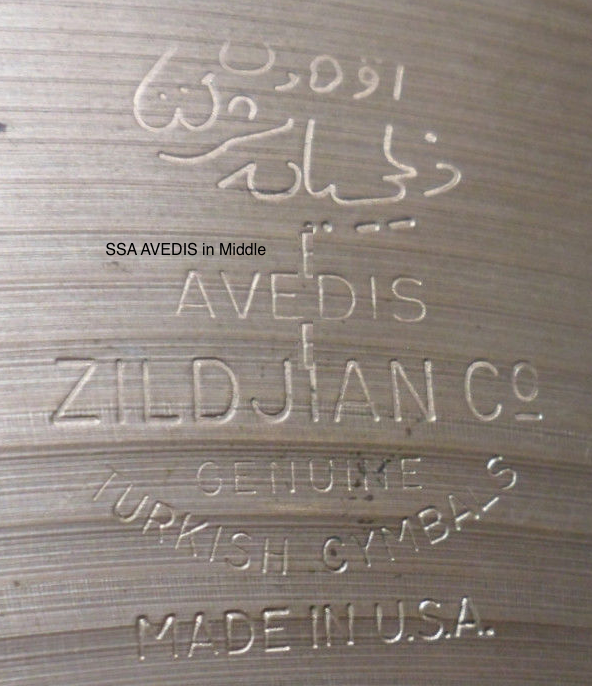
This copy/paste test is useful because it doesn't require somebody else to measure aspects of the trademark accurately enough to detect small differences. It also helps to cancel out the distortion effects of the focal length of the lens, how close the lens is to the surface, and any effects of the image being taken not quite square on and centered.
The AVEDIS isn't exactly in the middle. It might be a little lower than exact visual middle. All that really matters is that you can tell it apart from the next image which shows the lower placement.
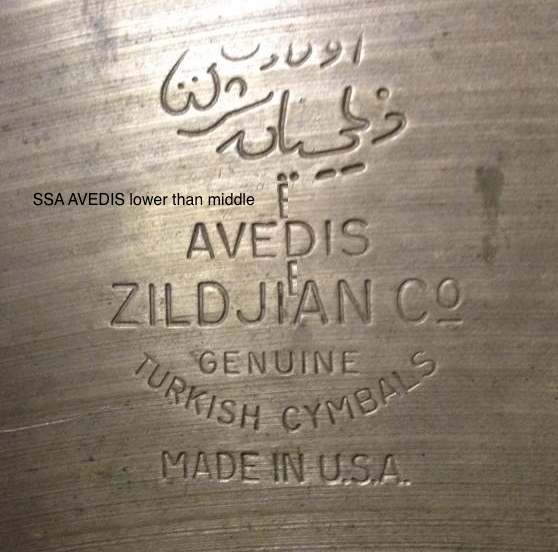
Image: SSA Lower Positioning
The above image shows the lower placement of AVEDIS. Again this is a subtle
distinction, but given a reasonable photo of a stamp I've been able to
pick the difference reliably without resorting to this copy/paste technique.
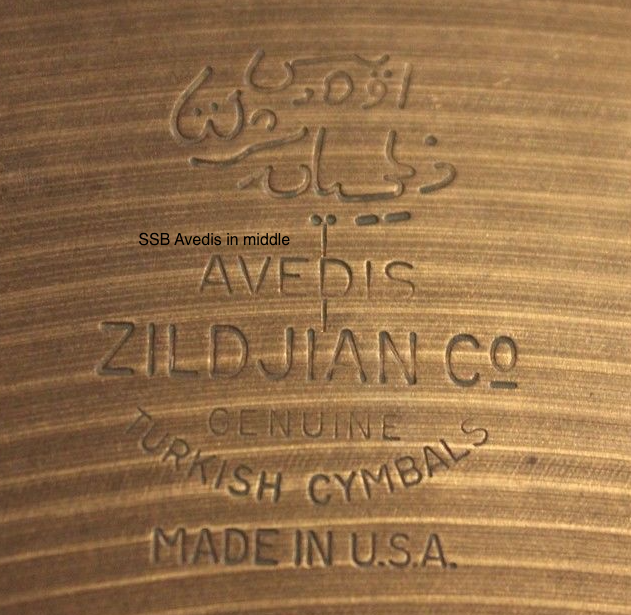
Image: SSB Middle Positioning
Above we see the SSB version of the AVEDIS positioned in the middle. This middle
position once again contrasts with the lower position shown next
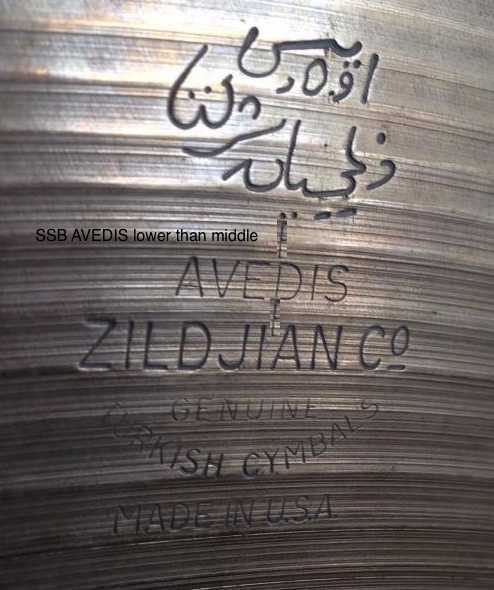
Image: SSB Lower Positioning
Again the distinction is subtle but detectable. But wait, there's more. Once
I started checking the SSB stamps using the copy/paste technique I
discovered a version which has a middle positioning but larger overlaps
on the top and bottom:
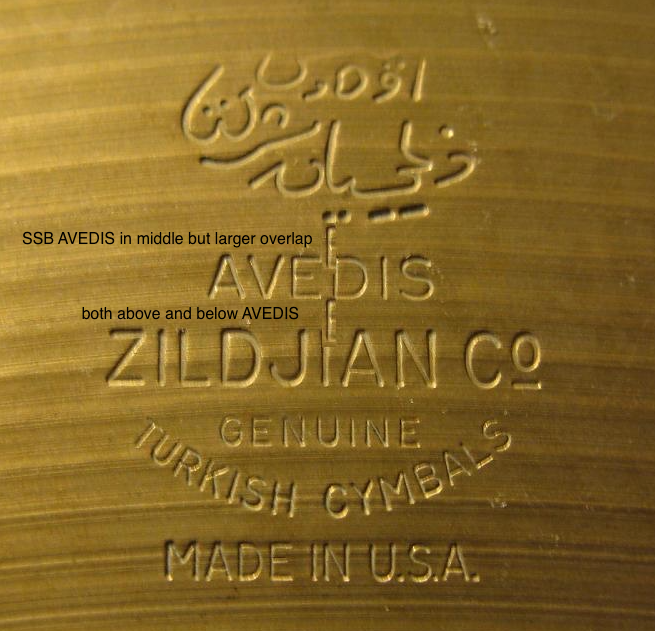
Image: SSB Middle Positioning Larger Overlap
The larger overlaps top and bottom are fairly obvious. It might be that
the AVEDIS is relatively larger in this version, or that the gaps are smaller.
Since this is all based on relative measures (relative to the height of the E of AVEDIS)
I don't know exactly what is going on. But I believe that this isn't just some
artifact of being pressed in differently. Also on current information from the
Trans Stamps onwards we're dealing with a single piece die, so it isn't because
the separate pieces were applied at slightly different distances apart.
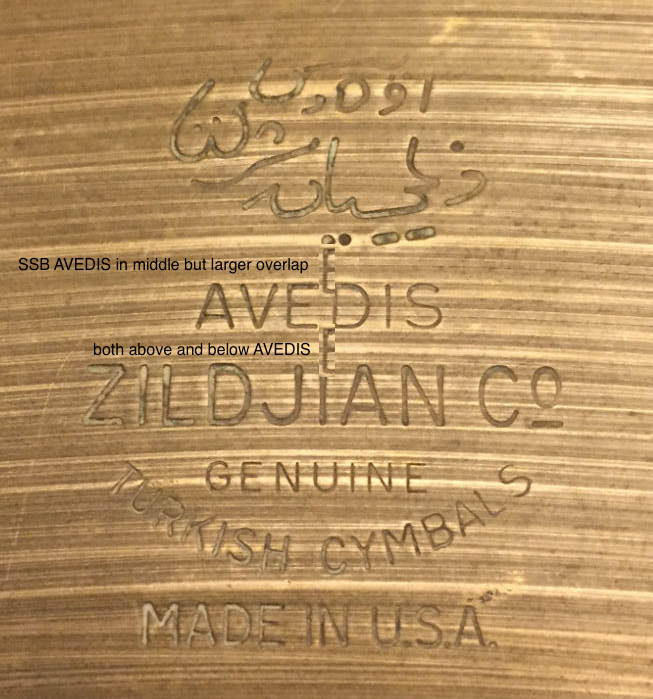
Since this is a radical new thing, here's a second example:
Image: SSB Middle Positioning Larger Overlap Second Example
This shows the same pattern of larger but about equal overlaps on both the
top and the bottom of the AVEDIS when using the E as a scale. What I haven't done
yet is fully test all the SSB middle position using the copy/paste E test to
see what proportion have the larger overlap.
So things just got complicated in the same way that
Pre Trans stamps
got
complicated when closely examined. The number of Pre Trans stamps went from 2 (first
and second) to 5 or more. It appears that there may similarly be 5 dies in use to
create Small Stamp pressings we observe. If there is an alternative explanation
to 5 dies I'm all ears. I'd prefer to keep things simple.
Cliff has suggested that the AVEDIS might seem to move around a bit is that
the stamp was made in 4 separate pieces.
Ottoman
which are all held together in a single holder. The holder might be tight,
but not tight enough to keep the AVEDIS portion from wandering slightly.
Perhaps enough to account for the middle versus lower positioning we are
seeing. If the dies are made of one solid piece then that's a different
story.
or back to the introduction page
text first created 12 Oct 2016 9:00 AM
AVEDIS
ZILDJIAN Co GENUINE TURKISH CYMBALS
MADE IN U.S.A
text last updated 15 Oct 2016 3:08 PM

This work is licensed under a Creative Commons Attribution-ShareAlike 4.0 International License.